Showing posts with label genealogy. Show all posts

Sunday, 28 February 2016

Heal, Ernal Carpenter (1882-1956)


The mysterious Mr Heal aka Frederick Hamilton.....(He would have loved the internet fame!).

The mysterious Mr E Heal. He is wearing a Silver War Badge which was distributed from Sept 1916 so this photograph was no doubt taken after that date. I have yet to find his WW1 service record.


I write this blog tentatively, not least in the fear that skeletons may come tumbling out of my great grandfather's closet. Ernal/Earnal Carpenter Heal is one of those family members that makes genealogy so frustrating and fascinating. He also teaches one the importance of the old adage 'always speak to family members first before trying to beat your head against a brick wall'.

From Heal to Hamilton.
The larger family mystery of my maternal grandfather was solved when speaking with a 2nd cousin who had been researching the family history. She had also lived with and known Ernal ( Fred) when she was a youngster. As far as I knew, my mum was born a Hamilton and her dad and his siblings were all born Hamilton. Ina ctual fact, the man that was married and died as Frederick Hamilton was born Ernal Carpenter Heal. The son of John and Margaret Heal.

Genealogists are only too aware that names can get mistranscribed on historical records. Dunbavin's can become Dunbavand's which in turn can become Dumbarton's, a Miller becomes a Mellor (or vice versa), a Bramwell can become a Brambell and so on. More often than not this can be a genuine mistake by the person transcribing the record for cataloging, the mishearing of a name from the census taker at the time or the recording of a cleric who thought it best to spell the name otherwise at the time of birth, marriage or death especially if the person being recorded was unable to read or write. They never considered that us folks may be blundering along 200 years from then trying to find our Davies who had been recorded a Davis.
This was obviously not the case for Ernal. Frederick Hamilton does not sound nor look anything like Ernal Heal.

It was no big surprise that it took sometime to find him and even then only through meeting with
my 2nd cousin. She even had a copy of his father's last will and testament which confirmed all stating he was leaving all to his son 'Earnal Carpenter Heal, professionally known as "Frederick Hamilton."'  I have been told Earnal was a singer and performer who had at some point ventured over to the States with the bright lights of Broadway calling. Possibly visiting his brothers and sisters who emmigrated to America there in the early 1900's. Frederick Hamilton would certainly have been his stage name but it was also a name he carried over into his married life and passed on to his descendants.

Part of the last will and testament of Earnal's father, John Heal, written in 1923 by John's solicitor. The will clarifies the names which Earnal is known by.
A salubrious family rumour of why Earnal may have changed his name, other than for 'professional' reasons, tells a story of Ernal leaving his Bolton birthplace not long after he was 18 following the discovery of a body in the railway tunnel near home. Some folks put 2 and 2 together to get 6. I have been wading through newspaper records and have yet to find any proof of a body being found or of Ernal's involvment in any such but I continue to search. I have to admit that I do find it difficult to talk of ancestors in less than glowing terms, especially when it feels like it hasn't been such a long time since their death (1959), however, from what has been gathered from family talk, Ernal was a bounder, a cad, a charmer and not necessarily in the nicest of ways.

Early Years.

On 14th June 1882 Ernal Carpenter Heal was born in Bolton, Lancashire to parents John and Margaret Ann Heal (nee Guthrie). Both parents had moved to Bolton from different parts of the country. John Heal (b.1855) came from the South West of England, from the town of Bradninch, Devon.  Margaret Ann Guthrie (b.1856) hailed from the North East, more specifically Lemington, Newcastle Upon Tyne which, back in the day, was in the county of Northumberland.
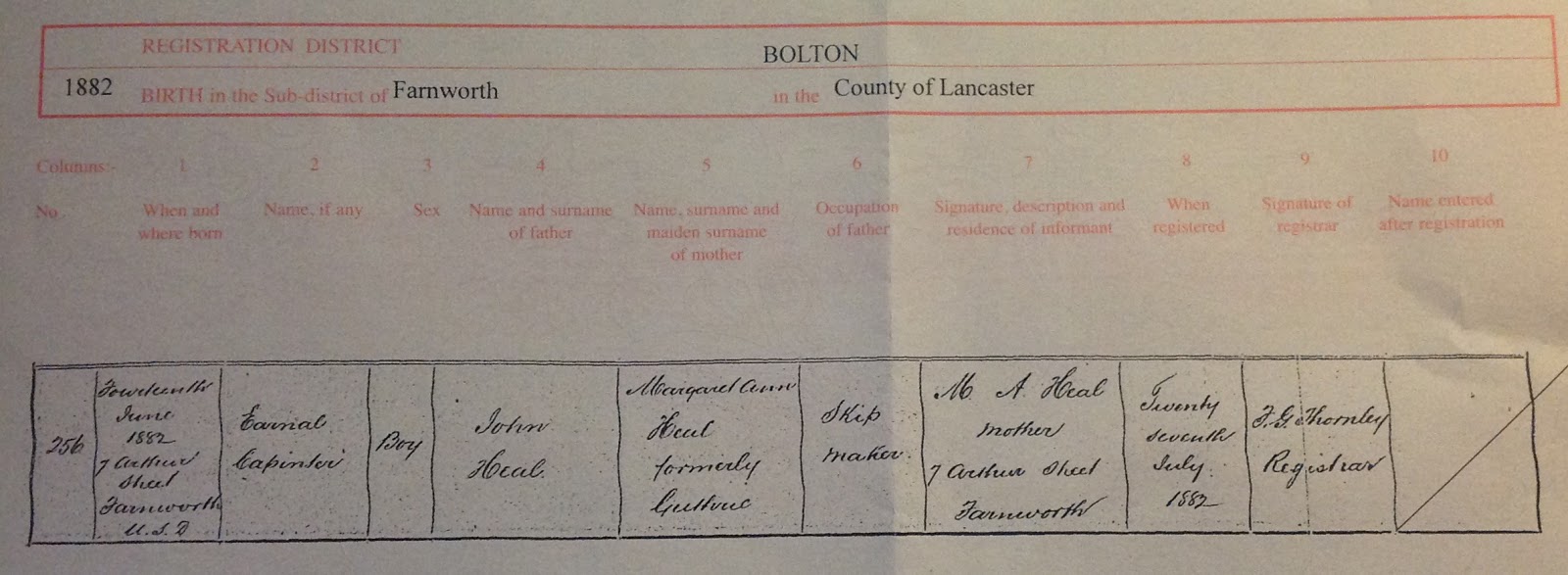
Birth record of 'Earnal Capinter'.

Ernal was the oldest born son and the fourth eldest child of 10 (that I know of) - Annie Regina (b.1875), Maria Jane (b.1877), Margaret (b.1880), Blanche Lucy (b.1885), Jessie (b.1886), Wilfred (b.1887), Sidney James (b.1890),  Kenneth (b.1893) and Daisy (b.1895).


Ernal (Ern) first appears in the 1891 England Census. He was was living at 7 Arthur Street in Farnworth, Bolton with mum, dad sisters Annie, Maria, Margaret and Blanche and brother Wilfred.

1891 Census - Ern Carpenter the Carpenter part of his name likely to be taken from the maiden name of John Heal's mother who was Ann Carpenter.

Ernal was still living with his parents in 1901 living at 30 Clarence Street, Farnworth, Lancashire along with his sisters, Margaret, Blanche and Daisy and brothers Wilfred, Sidney and Kenneth. By this time his elder sister, Annie Regina, had married a local chap, James Stephens and was living in Vernon Street, Farnworth, Bolton. His other sister Marie Jane and married a William Henry Roylance and was living on Bolton Rd, Clifton, Lancashire.

In the 1901 census Ernal was 18 years old. He was called 'Ernest' on the census, which is probably more to do with the census takers understandable translation of the unusual name of Ernal. He was working as a Coal Miner.

'Ernest' Heal - 1901 Census
A move to Wales and married life.
By the 1911 census, Ernal was living as Frederick Hamilton, married to Margaret Ann Michael and living in Ystradgynlais in South Wales and they already had 2 children Ena and Sidney (my grandad). It is difficult identify when (and why) Ernal made his way down to South Wales. He was working as a coal miner in one of the pits close to Ystradgynlais.

Frederick Hamilton - 1911 Census. Now married with 2 children.


Ernal married Margaret Ann Michael on 17 July 1909 and a week later their first daughter, Ena, was born. Sidney (my grandfather) came along the next year on 31 Dec 1910.

Ernal and Margaret went on to have more children and lived in Ystradgynlais until my grandad was about 15 years old. Family legends state that Ernal/Fred was a bit of a ne'er do well who had a roaming eye. It is understood Fred left the family and moved back up North. Margaret later went to find him before calling all the children up to Bolton, Lancashire where the family settled for good and Ernal/Fred went on to have more children.

Back up north.... Ernal's mother, Margaret, died in 1923 with his father, John, dying in 1925. At the time of his death, John Heal was living in the family residence of 21 Darley Grove, Farnworth which is where Ernal, Margaret Ann and their children eventually settled for many, many years to come.


Ernal/Fred and wife Margaret Ann (nee Michael)
Once living back up north, 21 Darley Grove became the much loved home for the 'Hamilton' family for many, many years to come. The 1939 register shows Ernal/Fred and his family residing at Darley Grove. At this time, Ernal stated that his occupation was as a 'fertiliser mixer' which a cousin astutely stated could be translated into 'shit stirrer'......

1939 Register, 21 Darley Grove - Frederick Hamilton 'Fertiliser Mixer'


The American Link
During my search for Fred/Ernal I discovered that some of his siblings had emigrated to the USA.  Annie, Blanche, Sidney and Kenneth all travelled to the USA between 1911-1924 and settled in Rhode Island, New England. It has been said that Ernal (as Fred) travelled over to the States and had even performed on stage musicals. The search still continues in this respect. His son Kenneth (my grandad's brother) was also a musician, singing in many clubs in the 60's and himself travelling over to the USA.

Death
Ernal Heal died at home on 20 April 1959 from a 'coronary occlusion due to atheroma'. He was 76 years old and his death was recorded under his 'professional' name of Frederick Hamilton. His wife continued to live in the family home up until her death in April 1970, a couple of months before her 80th birthday.  The search for more information about Ernal Heal continues.....

Timeline and facts:

Monarchs (1882 - 1959);  Queen Victoria, King Edward VII, King George V, King Edward VIII,
King George VI, Queen Elizabeth II.

Known addresses:
1882 - 7 Arthur Street, Farnworth, Bolton, Lancashire (Birth certificate).
1891 - 7 Arthur Street, Farnworth, Bolton, Lancashire (1891 Census).
1901 - 30 Clarence Street, Farnworth, Bolton, Lancashire (1901 Census).
1909 - Garden House, Cwmgiedd, Ystradgynlais, Brecon, South Wales (Marriage certficate).
1910 - 3 Pelican Street, Ystradgynlais, Brecon, South Wales (Birth certificate - son Sidney).
1939 - 21 Darley Grove, Farnworth, Bolton (1939 Register).
1942 - 21 Darey Grove, Farnworth, Bolton (Marriage certificate - son Sidney).
1959 - 21 Darley Grove, Farnworth, Bolton (Death certificate).

Known employment:
1901 - Coal Miner, Farnworth, Bolton, Lancs (1901 Census).

1909 - Coal Miner, Ystradgynlais, South Wales (Marriage certificate).
1911 - Coal Miner, Ystradgynlais, South Wales (1911 Census).
1939 - Fertiliser Mixer, Farnworth, Bolton, Lancs (1939 Register).
1959 - Inspector Royal Ordnance Factory, (Retired) (Death certificate).


Fred Hamilton aka Ernal Heal (centre) with my grandad Sidney Hamilton. Probably taken sometime in the 40's.


Sunday, 11 October 2015

Dumbarton, George Henry (1867-1909)

The Illusive Dumbarton...

George is my great grandfather and father to my paternal grandmother, Maggie Dumbarton. George could have stepped out of the pages of a Dicken's novel but unfortunately his story is only too real. He would end up being one of the countless folks of the 19th century who no doubt inspired Dickens to write some of his darkest Victorian tales. Workhouse and asylum admissions, his mother's prison admission, the early death of his father, the separation from siblings and parents, all before the age of 12. These things were all too common in 19th century Britain and George had the lot.

George initially proved to be rather illusive when I was trying to find him. He certainly taught me that one of the first things to realise when tracing ancestors is not to assume the name you have is the name you are looking for. You could be spending weeks trying to find a needle in the wrong haystack. Just because a chap was registered at marriage and death in one surname, doesn't necessarily mean his birth was registered with the same name. Oh the fun I had finding him! After many weeks I eventually asked for help on a forum. It worked, one very kind person managed to trace him, following which a cousin then produced the birth certificate! She knew all along but understandably didn't want to spoil my fun....

George Henry DUNBAVAND birth certificate
George was born George Henry Dunbavand and somewhere from birth to marriage his name changed to Dumbarton. It didn't help that he was born outside of Lancashire unlike the rest of his family. He had to be different! My own assumption (apologies for my generalisations) was that George may have been unable to read or write and thus unable to spell. The chap would have been at the mercy of any note takers and so 'Dunbavand' could possibly sound like 'Dumbarton' to anyone else, especially if a chap had a very strong accent or had had a few ales!

The story gets more complicated further back down the family line when the name changes backwards and forwards from Dunbavand to Dunbavin, Dunbobin, Dunbobbin, Duncavand, Donbavin, the list goes on. Oh the fun I have had with the Dunbavands!

And so to great grandad George...

Context for 1867.... The birth of George and...
  • Johann Strauss' Blue Danube premiered in Vienna.
  • Fyodor Dostoevsky was still bobbing around and married his stenographer Anna Snitkina in St. Petersburg.
  • The UK saw the introduction of the Second Reform Act which saught to extend voting rights.
  • Lord of all Chocolate, William Cadbury, was born.
  • In the US Jesse James and his gang were definitely up to no good.
  • Russia formally transferred Alaska to the US. The U.S. had bought Alaska for $7.2 million in gold.
  • Mount Vesuvius erupted. 
  • People waited in mile-long lines to hear Charles Dickens give his first reading in New York City.
  • In UK, the Second Reform Act was passed (seeking to extend voting rights but stopping short of all women and 'unskilled' working class men).
  • George Henry Dumbarton was born 12 April 1867 in Dudley, Worcestershire, UK.

Childhood...
George was born in Caddicks End.

George was born of George Dunbavand and Hannah Miller in Dudley, Worcestershire on 12th April 1867. It is unclear why George would be the only sibling born outside the North West of England. At the time of his birth his father was a glass cutter, glass making peaked in the nineteenth century and the Midlands was one of the major centres for glass production in the UK and the world and so it's quite possible the family moved to Dudley for work. When George was born they lived in Caddick's End which was very close to Castlefoot Glassworks in Dudley (see map of Dudley 1885).  At least 2 years prior to this, the family were  settled in Warrington where his older sister Betsy was born and, 2 years after his birth, they had settled back to Warrington where his younger brother Matthais was born (1869).
George was the second eldest of 4 surviving children. He had two younger brothers who died within their first year, Mathias (1869) and Samuel (1878). Betsy was the eldest, his second sister, Hannah, 5 years younger and the youngest child, Robert, was 8 years younger than George. George spent most of his life in the Warrington and Bolton areas.

Education...
National Schools Admission Register (9th row from the bottom).
 On 11th May 1874, when he was 7 years old, George started to attend Emmanuel Church of England School in Bolton. However, he left school school a few months later on 11th  August 1874 (National School Admission Registers & Log-Books 1870-1914). Later records of the National School Register (below) have George attending Pikes Lane School up until 27th March 1876 and then returning to Emmanuel Church of England School.

1870 Education Act

National Schools Admission Register (4th row from top).
Just before George was at the age where he would start to attend school, the government introduced the 1870 Education Act. The Act established a number of 'School Boards' to build and manage schools where needed.  This was implemented following pressure on the state to provide education where none existed.  In 1868 the National Education League began a campaign for free, compulsory and non-religious education for all children. 

Today in Britain, free, state education is seen as essential to a child's development and a legal requirement. When George would have been going to school, parents would have to pay a fee to ensure that their children received education. There was some provision for poor families made via the New Poor Law which meant that families deemed to be in extreme financial hardship would have places funded by the parish. In addition to this, many children would work outside school hours and so truancy also became a problem as children would go out to work to help the family live. A few years later, George and his family would be in trouble for breaching the 'School Board' act something which would no doubt have a big impact upon the family unit


Father's death, Strangeways Prison and Bolton Union Workhouse... 


On 25th January 1878, when George was 11, his father died at their home in Bolton. He was 34 years old. According to the death certificate his father died from 'internal strangulation of the intestines'. Hannah became a widow at the age of 32 and was left to support her 4 children, Besty, George, Hannah and Robert alone.

Just over a year later, on 20 Feb 1879, George's mother Hannah received a prison sentence. She was sent to HM Prison Manchester (Strangeways) for 7 days. The prison register records that Hannah was charged with 'breaching the school act' which could possibly be translated into the children not attending school. She was presented with the opportunity to pay a fine or go to prison. It was likely that Hannah had no other means of support and no money. She was sent to prison and her children George, Hannah and Robert were admitted to the Bolton Union Workhouse.


Georges' older sister Betsy, who by that time was 14 years old, was attending Kirkdale Industrial School in Liverpool, where she was a boarder and was also working as a reeler in a cotton mill.  Below is the admission record for George, Hannah and Robert and on the second page we see the reason for their admission being that their 'Mothers in gaol'. Sadly, this wouldn't be the last admission to the workhouse for George or indeed for his mother.

Bolton Union Workhouse Admission Register: 5th Row down (source: Bolton Archives History Centre)

Bolton Union Workhouse Register: 5th row down (source: Bolton Archives History Centre)

Growing up, working in the cotton mill...
Sunnyside Cotton Mill, Daubhill, Bolton - one of the many in Bolton at the time.
Two years later, when he was 13 years old, George, his mother and his younger brother and sister were all boarding with a George Hiles in Crown Street, Bolton. George was now employed as a cotton piecer in one of the local cotton mills. This was a difficult job but not an unusual one for a child from a poor background in the 19th century. Children were usually employed as 'piecers' due to the necessity for small, deft hands. Cotton piecers would work on the spinning mule whilst it spun cotton, getting it ready for weaving. The piecer had to ensure broken pieces of cotton were stuck back together. They would run between machines checking for threads and have to piece cotton together whilst the machine was still moving. It was a dangerous job and many young piecers had hands or fingers torn off by the moving parts of the machine.

Bolton mill boys(undated and unamed photo)
Here an extract is taken from an interview with a chap working in a cotton factory in the early 1900s. Whilst this was 20 years later, it gives us a little insight into the kind of work and circumstances George would be subject to at the age of 13.

"Where did you first start work?”
When I was twelve I went to this school across the road here and when I was twelve year old I got my half time paper, which was a blue paper and I went and got on at the spinning mill at Atherton and I worked half time, that’s from morning at six o’clock and I think it was ‘til twelve an then I’d come running home, had my dinner and went to school at the afternoon.

What was your job in the spinning mill? What did you do?
Well my job in the spinning mill was a little piecer and eventually when I got to full time at thirteen I must have got on a bit because the made me into a side piecer. So that was a promotion over little piecer.

These are mules we are talking about?
They were the mules, the spinning mules, yes. I stuck there until I was 15.

What did you wear when you were doing that job?
Well you wore a pair of white pants and nothing on your feet.

Nothing?
Nothing at all on your feet. You walked about between the mules with nothing on your feet making the ends up as they broke. Backwards and forwards as the come out and went in.

Did you ever get splinters in your feet?
Yes you did get splinters in your feet and then you’d go to the first-aid room and have it took out. All the time you were getting splinters in your feet. With the continued walking, you know the continued walking, and the oil, it got slippy with oil you know, it was like a dance floor, but that’s the way it was in the spinning mill. (Source: www.manchester.gov.uk)

Married life and children..

George and Sarah - Marriage 28 June 1890
On June 28, 1890 at the age of 23, George married Sarah Ellen Davies at St Thomas & St John's Church, Radcliffe, Lancashire. Sarah was 20 years old and lived in Radcliffe but, like George, she was born in the Midlands (Hanley, Staffordshire).  At the time of their marriage, George was working as a collier and the couple started out married life in Little Lever, Bolton. Whilst they moved around, they did remain in the Bolton area and had 8 children. Sadly, George (1892), Hannah (1894) and Robert (1896) all died within their first years. Thomas (1890), Stephen (1898), George William (1901), Violet (1904) and Maggie (1906 - my grandmother) were the surviving children.

Down t'Pit....
1890's Cornwall Miners; Photo JC Burrows
During this time George was employed as a coal miner and would have worked in one of the many pits in the area. In 1880 the Mines Inspector reported 534 coal pits in the Lancashire Coalfield. Of these 19 were in Bolton, 18 in Farnworth and Kearsley, 28 in Darcy, Great and Little Lever and 16 in Westhoughton. (Source http://www.lancashiretelegraph.co.uk/news/11314922.Bolton_s_mining_history/ ).

1890's Cornwall Miners: Photo JC Burrows


George would be working under extremely difficult and dangerous conditions where the risks of flooding, explosive gas leaks and pit collapses were all too real. Miners would work very long hours in very cramped conditions and illness was also a risk with common conditions including; stunted growth, crippled legs, curvature of the spine, skin irritations, heart disease, ruptures, asthma, bronchitis and rheumatism (source; http://www.historyhome.co.uk/peel/factmine/mines.htm).
By the 1901 Census George was still working as a coal miner in the Leigh area.

The workhouse, asylum and death....

It is difficult to know what circumstances lead up to George's illness and death or indeed how long he had been ill for. That's the frustrating thing about family history, the 'trying to fill in the blanks'. What we do know from records is that on 2nd November 1908, George was admitted to the Bolton Union Workhouse having been assessed by medical practitioner, Lewis Buck, who determined George was a 'person of unsound mind' and presented an 'Order for the Reception of a Pauper Lunatic'.  He was 41 years old.

Before the establishment of the National Health Service in 1948, Britain's workhouses provided much of the medical care needed for the poor. Throughout the 18th and 19th centuries they were the key providers of this medical care and as the19th century progressed they became the refuge for the elderly, sick and infirm poor.  Initially, George was admitted to Bolton Union Workhouse but this was only for a short period of time until a bed in the local asylum was found and after a few days stay at the workhouse he was transferred to Whittingham Asylum, Preston on 11th November 1908.


Lancashire Archives still retain the records of patients admitted to Whittingham. They have the 'Reception Order' for many patients and I was able to obtain the one for George which provides valuable insight into the circumstances surrounding his admission. The medical practitioner at the time, Lewis Buck, examined George and stated George was "...nervous, suspicious, depressed and that he says he has been dead once and is in fact full of delusions about his body”. Other evidence was presented by Charles Evans who was the attendant at the Bolton Union Workhouse at the time and, having observed George directly, stated that 'George Dumbarton has no memory, is very depressed does not know when he came here, thinks he is wasting away, sits up in bed crying saying his speech is leaving him and that he will not live more than a day'. In fact George died over two months later on 29th January 1909 at Whittingham Asylum. The cause of death was recorded as  'Exhaustion from General paralysis'.

George Dumbarton death certificate.


Timeline and known addresses:

1867 – BORN - Caddick's End, Dudley Worcester (Source; Birth certificate).
1869 – 2 yrs - Turners Street, Warrington (Source: Mathias (brother) baptism ;http://www.lan-opc.org.uk )
1871 – 4 yrs -  27 Church Street, Warrington (Source: 1871 Census)
1875 – 8 yrs  -  9 Joseph Lee Street, Bolton (Source: Robert baptism;http://www.lan-opc.org.uk )
1878 – 11 yrs - 43 Willows Lane, Bolton (Source: George Dumbavand death certificate)
1879 – 11 yrs -  Bolton Union Workhouse, Fishpool, Farnworth, Bolton (rootsweb)
1881 – 14 yrs - 26 Crown Street, Bolton (boarder with George Hiles, 1881 census).
1891 – 24 yrs -  8 High Street, Little Lever, Bolton (1891 Census)
1901 -  34 yrs -  59 Lower Green, Astley, Leigh (1901 Census)
1906 – 39 yrs -  7 Haynes Street, Bolton (Maggie Dumbarton: Birth Certificate)
1908 – 41 yrs  -  27 Georgina Street, Bolton ( Statement of Particulars: Reception Order for Asylum).
1908 – 41 yrs  - Bolton Union Workhouse – 2 November to 11 November 1908 (then transferred)
1909 – 41 yrs  -Whittingham Asylum, Preston Lancs – DIED 29 January 1909